
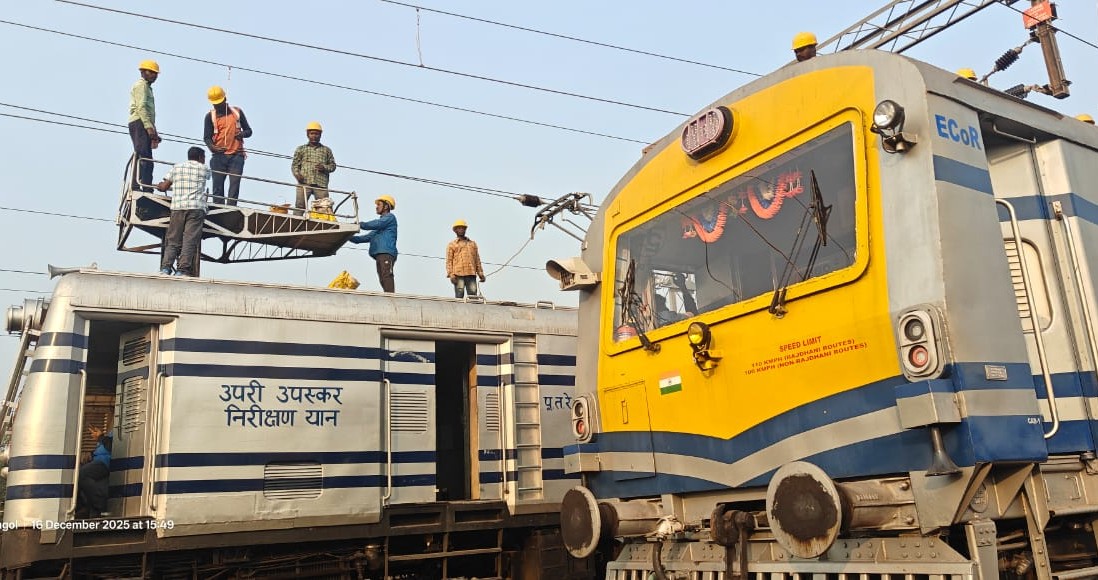
Railway Modernisation: East Coast Railway has successfully carried out safety-related modernisation and Non-Interlocking (NI) works at Rajathgarh Station between Rajathgarh and Joranda Road Railway Stations of Khurda Road Division in connection with commissioning of 3rd & 4th Line and aimed at strengthening infrastructure reliability and ensuring smoother, safer train operations in the region.
The works formed part of a comprehensive programme from 13th December to 20th December 2025 involving track re-arrangement, new track connections and rail crossing works, undertaken to modernise existing assets and prepare the section for future traffic growth.
Focus on Safety and Infrastructure Reliability
The Rajathgarh–Joranda Road section underwent thorough examination and upgradation of track and associated railway infrastructure. Key components modernised and renovated include track geometry and alignment, turnouts and crossings, signalling and interlocking systems, bridges and minor structures, overhead equipment interfaces, drainage arrangements, protective works and fencing/guarding. These measures are essential to ensure enhanced operational safety and long-term asset reliability.
Progress of 3rd & 4th Line Works
The modernisation works are closely linked with the ongoing 3rd and 4th Line capacity augmentation project in the Budhapank–Rajathgarh–Salegaon section between Cuttack and Angul. This vital corridor of national importance handles a large number of passenger and freight trains, including traffic catering to power houses and industrial hubs. The completion of NI works will facilitate faster execution of the additional line works and improve operational flexibility.
Major Restructuring in a High-Density Section
The Budhapank–Salegaon rail section is one of the busiest segments of the Khurda Road Division, carrying thousands of passengers daily and playing a crucial role in freight transportation. To meet increasing traffic demands, major restructuring and overhauling works were planned and executed, involving yard layout modifications, signaling changes, renewal of track components including sleepers and points and adjustments in overhead equipment. Special efforts were taken to ensure that these works contribute to safer and more punctual train services.
Passenger-Centric Approach
While a few trains were temporarily rescheduled or cancelled during the execution period, these measures were taken in the larger interest of passengers and future operational efficiency. Such planned interventions enable Indian Railways to deliver more flexible, reliable and punctual train operations in the long run.
Key Benefits of the Modernisation and NI Works
• Enhanced safety through upgraded track, signalling and interlocking systems.
• Improved infrastructure reliability and reduced maintenance requirements.
• Increased line capacity to handle higher passenger and freight traffic.
• Smoother and more flexible train operations on a high-density route.
• Better punctuality and operational efficiency for passenger and freight services.
Operational Management during NI Works
During the execution of the safety-related modernisation and Non-Interlocking (NI) works at Rajathgarh Station, meticulous planning was undertaken to ensure minimal repercussions to train operations, despite the high traffic density of the section.
Rajathgarh Station handles approximately 130 trains per day on an average in both directions, including a substantial number of passenger and coaching trains. To safely manage this heavy traffic during the NI period, well-planned operational measures were implemented in the interest of passenger safety and smooth train movement.
In view of the large volume of coaching train operations and to maintain safe and regulated movement through the yard, two pairs of trains were cancelled and about four to seven pairs of trains were diverted during the work period. These adjustments were kept to the bare minimum and were executed with prior planning to reduce inconvenience to passengers.
As part of the safety protocol during NI works, all signalling gears at Rajathgarh Station were disconnected, and train operations were carried out through manual setting of points. Since manual operations require additional time and enhanced vigilance, a temporary speed restriction of 30 kmph was imposed within the yard limits to ensure absolute safety during train movements.
These controlled operational measures ensured the safe execution of complex infrastructure works while maintaining continuity of essential rail services on this critical high-density route.
East Coast Railway remains committed to continuous infrastructure upgradation and safety enhancement, ensuring reliable rail connectivity and improved travel experience for passengers while supporting economic growth through efficient freight movement.