
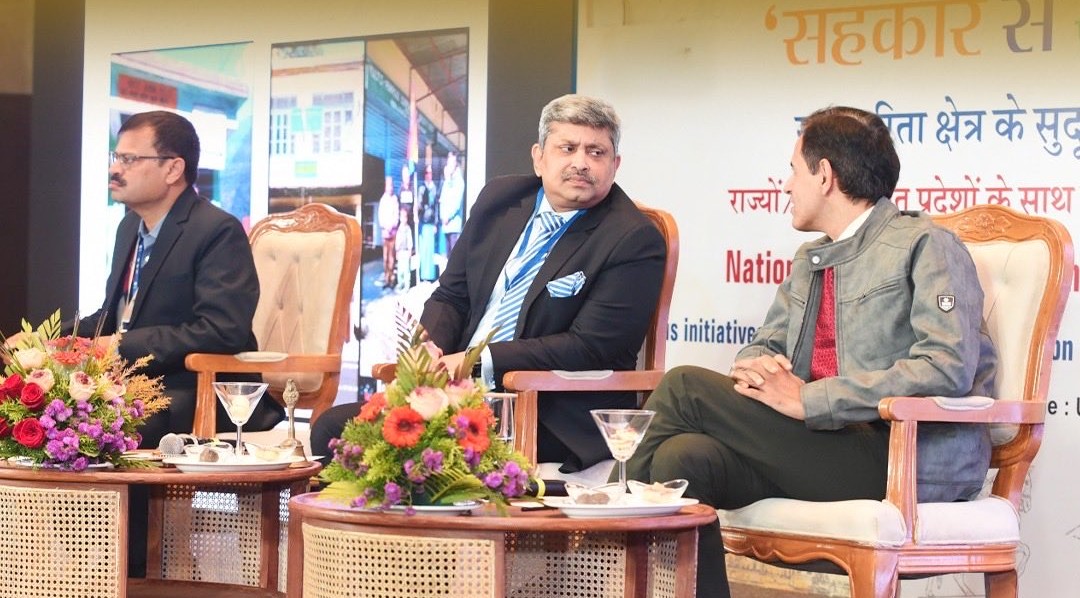
Sahkar se Samriddhi: Guided by the vision and leadership of the Prime Minister of India, Shri Narendra Modi, and his clarion call of “Sahkar se Samriddhi” to make cooperatives a key driver of inclusive growth, rural prosperity and grassroots economic empowerment, a two-day National-Level Workshop and Review Meeting on Strengthening the Cooperative Sector was held in Udaipur, Rajasthan, on 8–9 January 2026. Under the dynamic leadership of Shri Amit Shah, Union Minister for Home Affairs and Cooperation, the Ministry of Cooperation is translating this vision into action through wide-ranging reforms aimed at strengthening cooperative institutions, enhancing transparency and expanding their economic footprint across the country.
Organised by the Ministry of Cooperation, Government of India, the workshop brought together senior representatives from States and Union Territories, including Secretaries and Registrars of Cooperative Societies, along with key stakeholders from across the cooperative ecosystem. The workshop was inaugurated by Dr. Ashish Kumar Bhutani, Secretary, Ministry of Cooperation, in the presence of senior officers of the Ministry and other distinguished dignitaries. Smt. Anandhi, Secretary (Cooperation), Government of Rajasthan, welcomed the delegates of the conference to Rajasthan in her address.
In his keynote address, Secretary, Ministry of Cooperation emphasised that the workshop aimed to further strengthen coordination between the Centre and States/UTs, promote the exchange of ideas and encourage innovative approaches to revitalise the cooperative sector. He noted that cooperatives had remained on the margins for several years and underlined the need to bring them into the mainstream by reshaping public perception and highlighting positive success stories through traditional and social media. Referring to Banaskantha Dairy as a model example, he highlighted how a drought-prone district achieved milk production of nearly 90 lakh litres per day through the development of a strong and integrated value chain, demonstrating the transformative potential of cooperatives. He stressed key reform areas such as addressing dual regulation of cooperative banks, improving board election processes, encouraging field visits to understand grassroots realities and fostering a culture of consensus-based decision-making. He also highlighted the Ministry’s ongoing engagement with the RBI and the Ministry of Finance to simplify regulations for rural and urban cooperative banks and address administrative gaps.
Dr. Ashish Kumar Bhutani highlighted major initiatives undertaken to strengthen the cooperative sector, including the integration of Self-Help Groups with cooperatives, mandating cooperative institutions to open accounts with cooperative banks to enhance low-cost Current Account & Savings Account (CASA) funds, focused support for the North-Eastern Region, and capacity building through the proposed Cooperative University and training programmes in collaboration with LBSNAA, Mussoorie. He reiterated the vision of tripling the cooperative sector’s contribution to the economy through initiatives such as e-commerce platforms and value-chain development.
A dedicated review session examined the progress of key initiatives of the Ministry of Cooperation, including the computerisation of Primary Agricultural Credit Societies (PACS), Agricultural and Rural Development Banks (ARDBs) and RCS offices, as well as the implementation of schemes such as MPACS, Multipurpose Dairy Cooperative Societies (MDCS) and Multipurpose Fishery Cooperative Society (MFCS). Discussions also covered the world’s largest grain storage initiative and the expansion of additional services by PACS, including Common Service Centres, Pradhan Mantri Kisan Samriddhi Kendra (PMKSK) and PM Jan Aushadhi Kendras. Cooperative banking reforms and digital initiatives such as National Cooperative Organic Limited, National Cooperative Exports Limited and Bharatiya Beej Sahkari Samiti Limited, along with the promotion of White Revolution 2.0, were also deliberated.
Another key focus of the workshop was strengthening the National Cooperative Database and advancing reforms in Multi-State Cooperative Societies. States shared experiences on API integration, updating annual turnover and profit-and-loss data for GVA estimation, onboarding cooperatives on GeM, expediting liquidation processes and strengthening governance and e-commerce platforms for cooperatives. The workshop also emphasised building future-ready cooperatives through strong leadership, good governance and capacity building via institutions such as LBSNAA, Tribhuvan Sahkari University, National Council for Co-operative Training (NCCT) and Vaikunth Mehta National Institute of Cooperative Management (VAMNICOM), with special focus on enhancing opportunities for women, youth and marginalised communities.
As a continuation of the two-day National-Level Workshop and Review Meeting on strengthening the cooperative sector, a dedicated session on the second day titled “Sahkar se Samriddhi – PACS Ahead” focused on empowering Primary Agricultural Credit Societies (PACS) through targeted initiatives. The deliberations highlighted the pivotal role of cooperative banks in revitalising PACS, with States sharing their experiences and best practices. Key discussions included the implementation of cashless PACS and Management Information Systems (MIS), presented by Tamil Nadu; promotion of a startup ecosystem for cooperatives, presented by Andhra Pradesh; district-specific business plans presented by the Union Territory of Jammu & Kashmir; Model cooperative villages presented by NABARD; membership drive initiatives presented by Uttar Pradesh; and modern storage and supply-chain integration involving the Food Corporation of India (FCI) and States, presented by NABCONS, the consultancy arm of NABARD. The session underscored a comprehensive strategy to strengthen PACS, enhance their financial sustainability, and make them future-ready. Special sessions also focused on cooperative development in the North-Eastern Region, with presentations by Sikkim, Arunachal Pradesh and Manipur, and on “Sahakar Samvad: Dialogue with Successful Cooperatives”, which facilitated experience sharing on technology-enabled fisheries and dairy initiatives.
In the concluding session, Shri Pankaj Kumar Bansal, Additional Secretary, Ministry of Cooperation, chaired discussions on cooperation amongst collectives, focusing on integrating SHGs and FPOs with PACS and strengthening outreach under NCDC schemes.
In his closing address, Dr. Ashish Kumar Bhutani, Secretary, Ministry of Cooperation reiterated that PACS form the backbone of the cooperative system and emphasised the urgent need for their complete computerisation to strengthen rural financial inclusion. He noted that FCI has provided rental guarantees to expedite grain storage infrastructure, targeting 5 lakh tonnes by September 2026 and 50 lakh tonnes by September 2027. He thanked the Government of Rajasthan for the successful organisation of the workshop