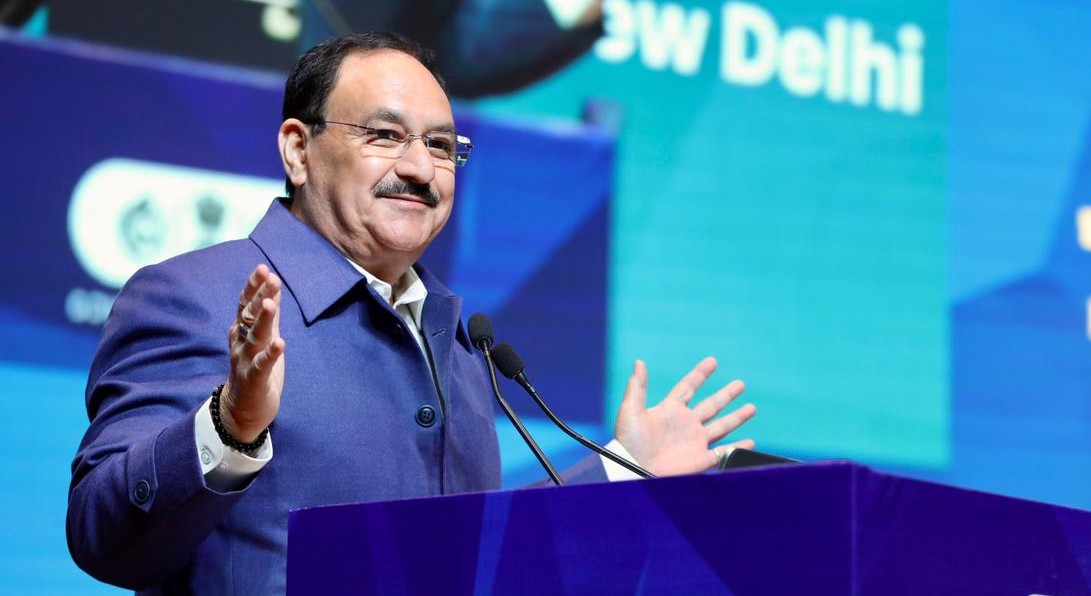
NCW Foundation Day: Union Minister for Health & Family Welfare and Chemicals & Fertilizers, Shri Jagat Prakash Nadda, today addressed the Foundation Day Programme of the National Commission for Women (NCW), reaffirming the Government of India’s steadfast resolve to promote women’s health, safety, dignity, and holistic empowerment.
Delivering the Keynote address, Shri J.P. Nadda, Union Minister for Health & Family Welfare and Chemicals & Fertilizers, underscored the Government’s vision of women-led development, emphasizing that the empowerment of women is central to India’s inclusive growth and social transformation. He also stated that, the 34-year journey of the Commission reflects how institutions earn recognition not merely through legislation, but through their commitment, sensitivity, and sustained action in addressing complex issues related to women.
Highlighting the paradigm shift in India’s healthcare policy under the leadership of Hon’ble Prime Minister Shri Narendra Modi, the Union Health Minister said that the country has moved from a predominantly curative approach to a comprehensive preventive and promotive healthcare model.
He noted that the National Health Policy, 2017 laid the foundation for integrated healthcare covering preventive, promotive, curative, palliative, and rehabilitative services. To deliver this vision, over 1.81 lakh Ayushman Arogya Mandirs have been established across the country to serve more than 1.4 billion citizens, with special focus on maternal and reproductive healthcare, which remains central among the twelve comprehensive healthcare service packages.
The Union Health Minister further informed that from the time a woman conceives until the child attains the age of 16 years, the Government ensures continuous healthcare monitoring, primarily through the dedicated efforts of ASHA workers. Through the U-WIN digital platform, a cohort of over 2.5 crore pregnant women and 2.5 crore children is currently being tracked to ensure timely immunization, antenatal care, and essential health interventions.
Between 2016 and 2024, more than 7.5 crore antenatal check-ups have been conducted, while institutional deliveries have increased by 89 percent over the past decade, significantly improving maternal and child health outcomes. He also highlighted the pivotal role of ASHA workers in ensuring free drugs, diagnostics, and timely transportation to healthcare facilities.
Shri Nadda also noted with satisfaction that India’s Maternal Mortality Ratio (MMR) has declined sharply from 130 per lakh live births in 2014–15 to 88 per lakh live births, marking a faster reduction than the global average. Emphasizing the preventive dimension of healthcare, he said that Ayushman Arogya Mandirs are playing a transformative role in early screening and detection of diseases.
As of Today, over 40 crore individuals have been screened for hypertension, leading to 6.8 crore diagnoses, while 40 crore have been screened for diabetes, resulting in 4.6 crore diagnoses. Similarly, 33.8 crore oral cancer screenings have identified over two lakh cases, 8.5 crore cervical cancer screenings have led to 90,000 diagnoses, and 15.8 crore breast cancer screenings have resulted in 75,800 detections, enabling early treatment and improved survival outcomes.
Addressing mental healthcare, the Union Minister highlighted the significance of Tele-MANAS, which provides round-the-clock mental health counselling in 20 languages, ensuring accessible, stigma-free support for women across diverse socio-cultural settings.
Furthermore, Union Health Minister highlighted that last year the Government launched the ‘Swastha Nari, Sashakt Parivaar Abhiyaan’, which witnessed an overwhelming participation of over 11 crore women across the country. Under the campaign, large-scale screening for non-communicable diseases (NCDs), tuberculosis, leprosy, and other health conditions was conducted, reflecting the Government’s proactive approach towards preventive and promotive healthcare. He noted that such targeted interventions are instrumental in early detection, timely treatment, and improved health outcomes for women.
In his concluding remarks, Shri Nadda affirmed that under the visionary leadership of Hon’ble Prime Minister Shri Narendra Modi, women-centric governance would continue to remain at the forefront of national policy-making. He called upon all stakeholders to renew their resolve for sustained reforms, stronger implementation, and accelerated progress to ensure better outcomes for women and to build a more inclusive, equitable, and empowered India.
The Foundation Day Programme witnessed the release of several important publications and the launch of key initiatives, reflecting the National Commission for Women’s comprehensive approach towards awareness generation, capacity building, and women’s empowerment.
These included the release of “Jagriti”, the monthly magazine of the National Commission for Women (NCW), aimed at promoting awareness on women-centric laws, rights, government initiatives, and inspirational success stories, and the Handbook on the “Maternity Benefit Act” designed to enhance understanding and ensure effective implementation of maternity-related legal provisions, thereby strengthening protection of women’s rights and workplace equity.
The programme also marked the launch of Pre-Marital Communication – Digital Training Modules, an innovative digital initiative to promote healthy communication, mutual respect, emotional well-being, and informed decision-making among couples, contributing to stronger family bonds and social harmony.
In addition, the ‘NCW Calendar on Women Scientists’ was released to celebrate the achievements and contributions of women scientists and to inspire young girls to pursue careers in science, technology, engineering, and mathematics (STEM). The occasion further featured the felicitation of eight Women Space Scientists under the theme “Aangan se Antariksh”, recognizing their exemplary contributions to India’s space and scientific endeavours and their role in motivating the next generation of women scientists.
The programme also included the award of scholarships under the ‘Shakti Scholars Youth Research Fellowship’, aimed at encouraging young women researchers and scholars to pursue innovative research and contribute meaningfully to nation-building.
Smt. Annpurna Devi, Minister of Women and Child Development, Smt. Savitri Thakur, Minister of State, Ministry of Women and Child Development, Shri Sudeep Jain, Member Secretary, NCW, and Smt. Vijaya Rahatkar, Chairperson, National Commission for Women and Senior officials from Ministry, representatives of civil society and academicians were also present at the event.