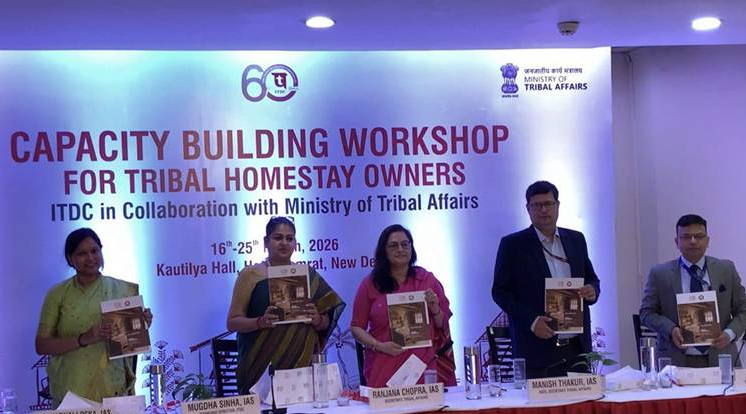
Tribal Homestay Owners: The India Tourism Development Corporation (ITDC), under the Ministry of Tourism in collaboration with the Ministry of Tribal Affairs, held the inaugural opening ceremony of the Capacity Building Program for Tribal Homestay Owners at Kautilya Hall, Hotel Samrat, New Delhi.
The initiative marks an important step toward promoting community-based tourism while strengthening the professional hospitality skills of tribal homestay operators across the country. The programme aims to enhance service standards, improve visitor experiences, and support sustainable livelihood opportunities for tribal communities through structured training and capacity building by IHM Ashok, ITDC for Ministry of Tribal Affairs. The program was attended by first batch of 40 participants from Arunachal Pradesh, Sikkim and Gujarat.
The ceremony was attended by Smt. Ranjana Chopra, IAS, Secretary, Ministry of Tribal Affairs; Mr. Manish Thakur, IAS, Additional Secretary, Ministry of Tribal Affairs, Ms. Mugdha Sinha, IAS, Managing Director – ITDC, Dr. Varnali Deka, IAS, Director, Ministry of Tribal Affairs and Mr. Rajesh Rana, Director, Commercial & Marketing, ITDC.
A key highlight of the event was the release of the publication developed by IHM Ashok, titled “Tribal Homestay – Operation & Development Manual 2026.” The manual provides a structured framework to support the development and professional management of tribal homestays across India. Designed as a practical guide for aspiring and existing homestay operators, the publication has been developed as a multilingual resource and translated into Hindi and Gujarati to ensure wider accessibility and effective outreach among communities.
Commenting on the occasion, Secretary of the Ministry of Tribal Affairs said, “The mindset of the Indian tourist is evolving. Today’s travellers are increasingly seeking destinations that are less crowded, closer to nature, and free from pollution, while also choosing to stay longer to truly experience these environments. In a country where there is a significant shortage of hotel rooms, the homestay model offers a powerful solution.”
She further said, “It not only meets the expectations of modern travellers but also creates meaningful livelihood opportunities for tribal households, particularly in mountainous and tribal regions rich in natural trails. By equipping homestay owners with the basic principles of hospitality, this initiative has the potential to transform local economies. As ITDC celebrates sixty years of excellence, this partnership with the Ministry of Tribal Affairs is a significant milestone. The small seed we are planting today through this training programme will grow into a strong and sustainable model that inspires many more communities to adopt tourism-led livelihood opportunities.”
Speaking on the occasion, Ms. Mugdha Sinha, IAS, Managing Director – ITDC, said, “The homestay movement in India draws strong inspiration from the Hon’ble Prime Minister’s vision of establishing one lakh homestays across the country. Our immediate effort to train 1,500 participants is only the beginning. The larger goal is to empower them to become trainers of trainers in their respective states, enabling the model to expand rapidly and ensuring that communities can access training closer to home.”
She also added, “This initiative also reflects our commitment to breaking silos and working through meaningful collaboration. By bringing together the strengths and synergies of the Ministry of Tribal Affairs, the Ministry of Tourism, and the Incredible India platform, we are creating a framework that supports sustainable tourism while generating new livelihood opportunities for communities across the country.”
The collaboration between ITDC and Ministry of Tribal Affairs reflects the government’s broader focus on inclusive development and generating livelihoods through tourism. This also aims to strengthen community-based tourism by equipping tribal homestay operators with the skills and knowledge needed to deliver high-quality experiences. It also contributes to sustainable development by generating meaningful economic opportunities while preserving tribal traditions.