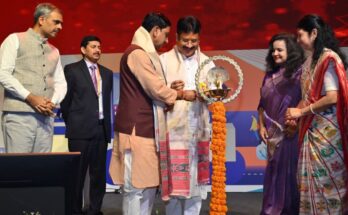
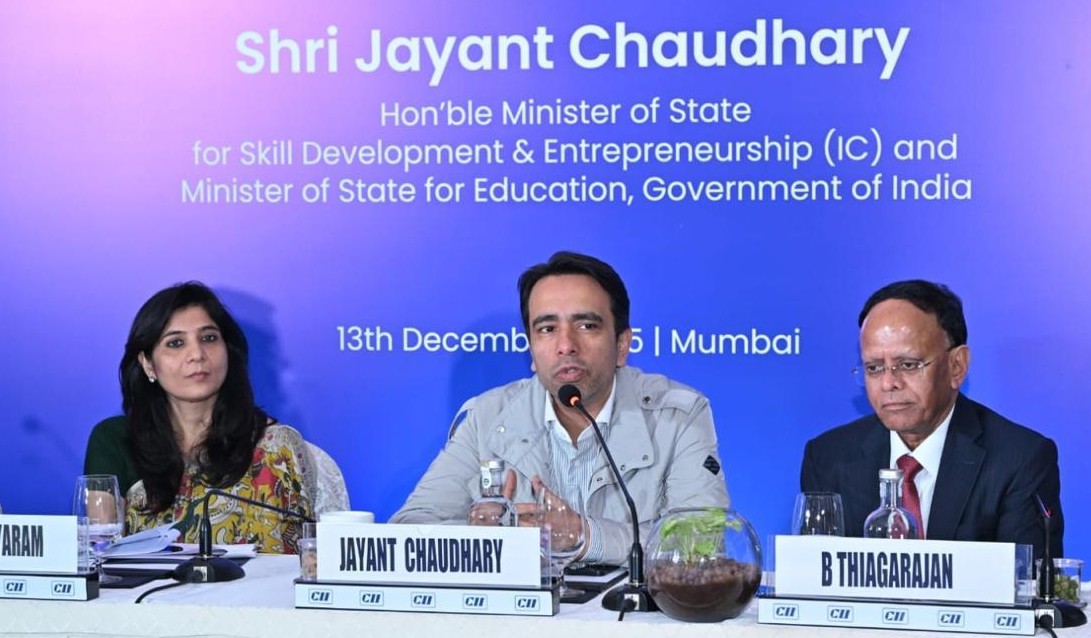
Industry–Government Partnership: The Ministry of Skill Development and Entrepreneurship (MSDE), in partnership with the Confederation of Indian Industry (CII), organised a high-level Industry Interaction on “Fostering Industry–Government Collaboration for Skilling Talent” at Taj Mahal Palace, Mumbai.
The interaction was chaired by Shri Jayant Chaudhary, Minister of State (Independent Charge) for Skill Development and Entrepreneurship and Minister of State for Education, Govt of India and brought together senior industry leaders to deliberate on strengthening industry-aligned skilling frameworks and improving employability outcomes. The workshop witnessed participation from experts and representatives from key sectors including Education, Health, Hospitality, Banking and Manufacturing.
Addressing the gathering, Shri Jayant Chaudhary highlighted that India is at a critical juncture where rapid technological change, evolving workplace models and demographic shifts are reshaping skill requirements across sectors. He noted that persistent skill mismatches—where employers struggle to find job-ready talent despite a large youth workforce—underscore the need for deeper and more structured industry–government collaboration.
The Minister outlined the Government’s ambition to build a coherent national framework for Centres of Excellence (CoEs) with a clear focus on advanced skills, industry relevance and measurable employment outcomes. He emphasised that CoEs are envisioned as anchors for high-end skilling, trainer excellence and curriculum innovation, closely linked with industry demand.
Shri Jayant Chaudhary also highlighted the Government’s flagship initiative PM-SETU (Pradhan Mantri Skilling and Employability Transformation through Upgraded ITIs) as a transformational reform to reposition ITIs as aspirational, modern and outcome-driven institutions. With an estimated outlay of ₹60,000 crore, PM-SETU aims to upgrade 1,000 government ITIs into industry-aligned Centres of Excellence through a hub-and-spoke model, linking 200 hub ITIs with 800 spoke ITIs to scale quality vocational education nationwide. A key feature of the PM-SETU scheme is industry-led governance through a Special Purpose Vehicle (SPV). The SPV will play a crucial role in financial management, infrastructure and equipment development, monitoring and evaluation, stakeholder engagement and industry collaboration.
“PM-SETU represents a systemic shift in how vocational institutions engage with industry. By embedding industry participation in curriculum design, trainer exposure, apprenticeships and placements, we are creating ITIs that are relevant, aspirational and directly aligned with labour-market needs—both domestic and global,” the Minister said.
The Minister further spoke on the strategic role of Skill India International Centres (SIICs) in supporting global mobility and urged industry to actively partner in operationalising SIICs as gateways for international-standard training and overseas employment opportunities. He also highlighted the recent Cabinet approval of India’s participation in the World Economic Forum’s Skill Accelerator, noting that it will help align India’s skilling ecosystem with global best practices and future workforce trends.
Emphasising outcome measurement and transparency, Shri Jayant Chaudhary underscored the importance of the Employability Matrix as a credible, standardised index to assess job readiness across sectors. He also highlighted the growing relevance of APAAR IDs and Academic Bank of Credits (ABCs) in enabling flexible learning pathways, credit portability and lifelong upskilling. On apprenticeships, the Minister reiterated the Government’s focus on scaling participation under NAPS and NATS, calling apprenticeships a critical bridge between education and employment.
Smt. Archana Mayaram, Economic Advisor, MSDE, set the context for the roundtable discussions by highlighting the widening disconnect between industry demand and available skills. Alongside making a presentation on PM-SETU, she noted that employers increasingly struggle to find candidates with the right competencies, while rapid technological change requires industry to constantly stay abreast of emerging skills.
Referring to changing workforce expectations, she observed that Gen-Z aspirants often seek quicker returns and face anxiety around career stability, making it essential to raise the aspirational value of skills, strengthen self-esteem and create visible pathways to meaningful employment—an objective that initiatives like PM-SETU seek to address.
Speaking on behalf of industry, Mr. B. Thiagarajan, Chairman, CII, emphasised the need for industry to act as a co-creator in the skilling ecosystem, working closely with government to ensure training remains responsive to workplace realities and future growth sectors. Mr. Ashank Desai, Chairman, Mastek, highlighted the need to evolve new and collaborative skilling models, emphasising that closer partnerships between industry, training institutions and government will be essential to keep pace with emerging industry requirements and rapidly changing technology landscapes.
During interactive session, industry stakeholders exchanged views with CII representatives and the Minister on how various industries can contribute to skill development in partnership with the government. Experts highlighted that aligned training programs and stronger placement linkages can significantly enhance enrolment and employment opportunities for trainees.
The deliberations focused on strengthening industry-led skilling models, modernising training institutions, expanding apprenticeships and improving labour-market responsiveness. Participants reaffirmed that sustained collaboration between government and industry will be critical to building a skilled, confident and future-ready workforce capable of supporting India’s economic growth and global competitiveness.