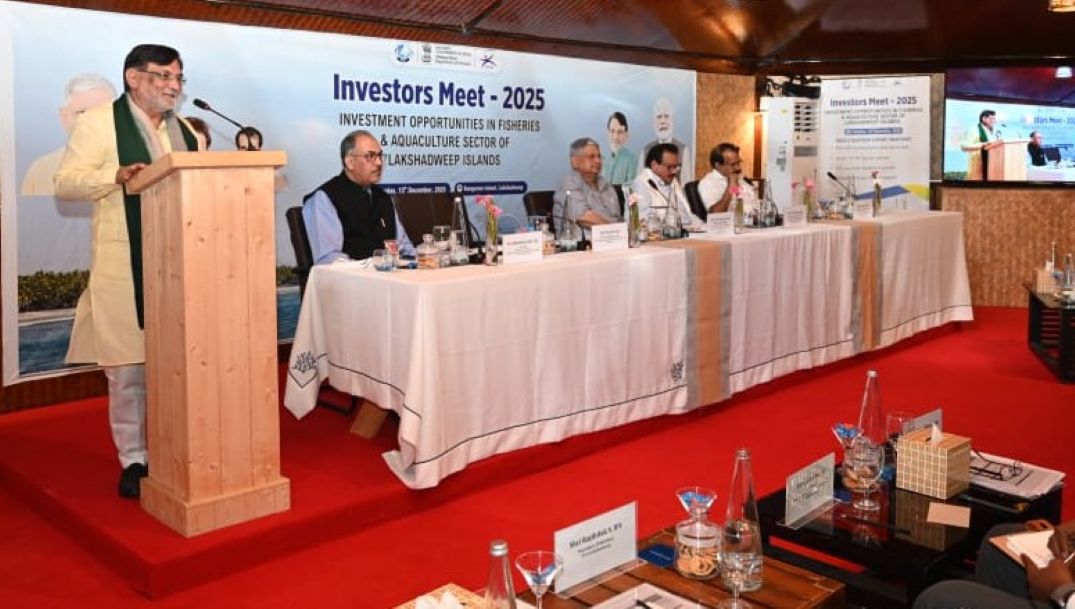
Lakshadweep Investors’ Meet: The Department of Fisheries organized First-ever Investors’ Meet organized in Lakshadweep Islands to unlock untapped Fisheries potential in Bangaram Islands, UT of Lakshadweep in the august presence of Union Minister Shri Rajiv Ranjan Singh, Ministry of Fisheries, Animal Husbandry & Dairying and Ministry of Panchayati Raj; Ministers of State Prof. S.P. Singh Baghel, MoFAH&D and Panchayati Raj; and Shri George Kurian, MoFAH&D and Minority Affairs; and Shri Praful Patel, Administrator of Lakshadweep.
This was a first-of-its-kind Investors’ Meet organized in the UT wherein about 22 Investors and key entrepreneurs working in the areas of tuna and deep-sea fisheries, seaweed cultivation, ornamental fisheries, and waste management, etc. participated from across the Country.
The Department of Fisheries, GoI highlighted 4 key areas for Investment opportunities in the Fisheries and aquaculture sector during the meeting.
Tuna & Deep-Sea Fisheries Development Opportunities
Opportunities exist in tuna fishing, processing, canning, value-added products, branding and exports. Lakshadweep offers immense potential for investment in tuna and deep-sea fisheries, with it possesses nearly 20% area of India’s Exclusive Economic Zone and supporting rich stocks of tuna and other high-value species. Despite this, the current production of around 15,000 tonnes represents only a fraction of the estimated one lakh tonnes potential. By developing a modern value chain that includes fishing, certification, branding and export-oriented processing, investors can help position Lakshadweep tuna in premium international markets under a strong identity such as “Lakshadweep Sustainable Tuna.”
Traditional fishing practices in the region make it ideal for global eco-labelling systems like Marine Stewardship Council (MSC), which can unlock access to high-end markets and premium pricing. Opportunities also exist in infrastructure development, including smart fishing harbors, cold chain facilities, and processing units, as well as fleet modernization through advanced multi-gear deep-sea fishing vessels equipped with onboard storage and processing, and mother vessels for catch aggregation and transportation. These initiatives collectively promise to transform Lakshadweep into a hub for sustainable, globally competitive tuna fisheries.
Seaweed: Offshore Farming, Biomass Processing, Bioproducts
Lakshadweep’s vast lagoon area of more than 4200 sq. kms provide an ideal environment for seaweed cultivation, and with global demand for seaweed-based products rising rapidly, the region presents significant investment opportunities in farming systems, nurseries, biomass processing, and bioproduct manufacturing. As a notified Seaweed Cluster, Lakshadweep has already established a strong foundation under PMMSY through initiatives taken, such as a Seaweed Seed Bank, and a Seaweed Hatchery, paving the way for accelerated sectoral growth.
The Lakshadweep Administration is also working on a leasing policy to facilitate offshore seaweed farming by the private sector. Investors can capitalize on this momentum by expanding seaweed farming, processing capacities, logistics networks, and market linkages to position Lakshadweep products in global markets. Beyond economic potential, seaweed farming offers environmental benefits such as carbon sequestration and marine biodiversity enhancement, while supporting diverse industries including food, pharmaceuticals, and cosmetics.
Ornamental: Hatcheries, Brood Banks, Integrated Units
Lakshadweep is home to nearly 300 species of marine fish suitable for the ornamental trade, spanning around 35 families such as wrasses, damselfish, cardinalfish, groupers, surgeonfish, butterflyfish, goatfish, blennies, scorpionfish, triggerfish, and squirrelfish. This rich biodiversity makes the islands an ideal destination for establishing marine ornamental hatcheries, broodstock development facilities, and integrated rearing units aimed at reducing dependence on wild-caught species. With growing global demand for ornamental fish, investors have an opportunity to tap into the lucrative aquarium trade by developing sustainable breeding systems, export-oriented enterprises, and conservation-friendly practices that also generate local employment and position Lakshadweep as a key player in the international ornamental fish market.
Offshore Cage Farming
Lakshadweep holds immense potential for offshore cage farming, leveraging its vast Exclusive Economic Zone of nearly 4 lakh sq. km to promote large-scale, sustainable mariculture. This sector is backed by successful pilot initiatives that demonstrate its viability in other areas of country. A notable pilot study was conducted by NFDB in collaboration with local cooperatives and CMFRI, deploying 30 cages for species such as sea bass, pompano, and mullets in Balasore, Odisha. Another pilot project, supported by PMMSY and funded through JSW Jaigarh Port Limited’s CSR initiative, introduced 30 cages using CMFRI technology in partnership with cooperatives. These pilots underscore the technical feasibility and commercial promise of offshore cage farming, paving the way for investors to scale operations and position in Lakshadweep as well, as a hub for modern mariculture.
To facilitate investment and streamline processes, a single-window system is being developed for smooth project approvals in Lakshadweep. This Investors’ Meet has already generated strong interest, with more than ₹500 crore worth of investment proposals envisaged, promising future to unlock the immense potential of Lakshadweep’s Blue Economy while ensuring sustainable growth.