
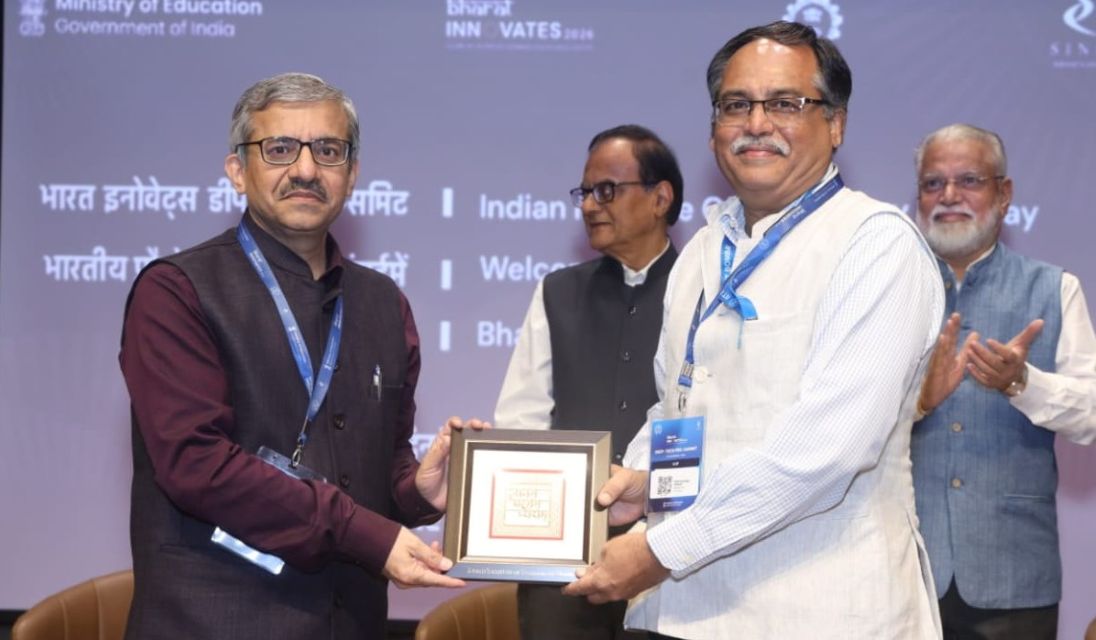
Bharat Innovates: The Bharat Innovates Deep-Tech Pre-Summit, a landmark national showcase of India’s most promising deep-technology ventures, was inaugurated today at ASPIRE – IIT Bombay Research Park Foundation on the IIT Bombay campus in Mumbai.
The two-day event was inaugurated by Prof. Ajay Kumar Sood, Principal Scientific Adviser to the Government of India and Chairperson of the Prime Minister’s Science, Technology & Innovation Advisory Council (PM-STIAC), in the presence of senior dignitaries from the Government of India.
The distinguished gathering included Dr. Vineet Joshi, Secretary, Department of Higher Education, Ministry of Education; Prof. Abhay Karandikar, Secretary, Department of Science and Technology; Dr. K. Radhakrishnan, Chairperson, Board of Governors, IIT Bombay; and Prof. Shireesh Kedare, Director, IIT Bombay.
The Pre-Summit serves as a precursor in the Bharat Innovates 2026 journey that culminates in India’s global innovation debut at Nice, France, in June 2026, as part of the India-France Year of Innovation 2026, announced by the Prime Minister, Shri Narendra Modi.
Delivering his inaugural address, Chief Guest Prof. Ajay Kumar Sood emphasised the importance of deep-tech innovation to India’s technological leadership and global competitiveness, highlighting the role of academic institutions, research ecosystems, and startups in advancing cutting-edge technologies.
In his address Dr. Vineet Joshi, Secretary, Department of Higher Education, Ministry of Education, underscored that Bharat Innovates 2026 as a whole-of-government effort bringing together the Ministry of Education, the Department of Science and Technology, the Department of Biotechnology, the Space Department, and the Ministry of Defence on a single platform to demonstrate India’s cutting-edge deep-tech capabilities to the world. Emphasising that the initiative is as much about transforming India’s education ecosystem as it is about global showcasing.
He noted that the National Education Policy 2020 has already triggered a significant shift from equating education with examination scores to recognising its true purpose as a meaningful contribution to society, with conviction towards realizing the vision of Viksit Bharat by 2047. He called on investors and corporates to help identify promising startups beyond the metros, reiterating that innovation is not confined by geography.
Dr. K. Radhakrishnan, Chairperson, Board of Governors, IIT Bombay, addressed the assembled innovators and founders to work with conviction and national purpose, and invited them to write a new history for India. Further, he called innovators as ambassadors of India and encouraged them to make India proud.
Prof. Abhay Karandikar, Secretary, Department of Science and Technology, offered a wide-ranging perspective on India’s innovation trajectory and the decisive policy steps underway. He noted that India is now the third-largest startup ecosystem in the world with approximately 2 lakh startups and around 125 unicorns—a remarkable rise from just 24 unicorns in 2017–18. Over 1,000 investors are now active in India and nearly ₹70–80 billion in venture capital has flowed into Indian startups in recent years.
Highlighting the gap in deep-tech financing, Prof. Karandikar noted that of total venture capital investments, only about $4–5 billion has gone into deep tech. To decisively address this, he announced that in July 2025, the Union Cabinet approved a historic ₹1 lakh crore Research, Development, and Innovation (RDI) Fund—focused on private sector R&D, including startups, through equity participation and flexible long-term financing. The Technology Development Board (DST) and BIRAC (DBT) have been identified as fund managers, with alternative investment funds and IIT Research Parks also to be engaged. DST currently nurtures nearly 30–40% of India’s estimated 8,000– 10,000 deep-tech startups through the National Mission on Cyber-Physical Systems, the National Quantum Mission, and NIDHI seed support schemes.
Praising the IIT and IISc ecosystem, Prof. Karandikar said, “The IITs and IISc have a big role to play in nurturing the deep-tech ecosystem.
In his welcome address, Prof. Shireesh Kedare, Director, IIT Bombay, described Bharat Innovates as not merely an event but a deep-tech ecosystem that rests on three pillars: the education system, strategic investors and corporate sector for market access and real-world grounding that transforms technology into impact. He noted that more than 3,000 startup applications were received from across the country, from which 137 of India’s most promising deep-tech startups were selected through a rigorous multi-stage evaluation process spanning 13 thematic areas.
Following the inauguration, the dignitaries walked through the startup exhibition, interacting with founders and exploring innovations presented across dedicated startup stalls and the IIT pavilion. More than 70 startups presented their ideas across multiple parallel pitch sessions, followed by reverse pitches from leading investors and industry representatives highlighting priority investment areas and industry-driven technological challenges.
The Bharat Innovates 2026 Deep-Tech Pre-Summit brings together stakeholders from across India’s innovation ecosystem and provides a national platform for emerging startups to connect with investors, industry leaders, and policy makers ahead of the global showcase in France.
The Bharat Innovates 2026 programme showcases innovations across 13 critical technology domains, including Advanced Computing, Healthcare & MedTech, Space & Defence, Energy & Sustainability, Semiconductors, Biotechnology, Smart Cities & Mobility, Blue Economy, Next-Gen Communications, Agri & Food Technologies, Advanced Materials, Manufacturing & Industry 4.0, and Disaster Management.