PIF Report: Pahlé India Foundation(PIF)hosted a discussionon “Viksit Odisha: Progress, Prospects and the Roadto 2047” at Vivanta Bhubaneswar, DN Square, on Friday, 23 October 2026. The event was graced by Smt Anu Garg, IAS, Chief Secretary, Government of Odisha, as the Chief Guest, alongside government officials, industry representatives and members of academia. Discussions centred on Odisha’s economic progress, investment opportunities and the priorities that will shape its development over the coming decades.
Delivering the key note address, Dr Rajiv Kumar, Chairman, Pahlé India Foundation and former Vice Chairman of NITI Aayog, examined the structural changes needed to sustain Odisha’s economic growth. He stated, “Odisha produces44% of India’s mineral value, but mining must be run as a high-value, high-capex industry. That means pairing minerals with ports and moving into green steel, green aluminium, green hydrogen and rare-earth magnets.
Merchandise exports, now about $11 billion, need to reach $100 billion by 2036. Today eight districts generate 83% of merchandise exports, while the bottom 15 contribute barely 2%. To change this, he proposed a four-part formula for each lagging district: its One District One Product item, a global anchor buyer, a shared processing facility, and a road or rail link to a port. With its working-age window open until 2036, Odisha must skill its youth for the industries it is attracting.”
Reflecting on the state’s longer-term economic prospects, Dr Kumar also noted that Odisha’s economy has grown ten fold over the past two decades. He added, “Sustained nominal growth of10% would make it developed economyby2047, with a per capita income of about$18,000, well above the World Bank’s threshold for a developed, high-income economy. Getting there will need high-value mining, green metal sand global anchor firms in selected districts. It will also need the bottom half of Odisha’s districts, which together contribute barely 2% of merchandise exports, brought into global value chains.”
Addressing the gathering, Smt Anu Garg, IAS, Chief Secretary, Government of Odisha, highlighted the state’s vision of becoming a $500 billion economy by 2036 and a $1.5 trillion economy by 2047, in alignment with the national vision of Viksit Bharat 2047. Outlining the state’s development strategy, she highlighted the “EDGE framework-Economic Strength, Demography, Geography and Ecosystem” as a key pillar for realising the vision of Viksit Odisha. Under Economic Strength, she stressed the importance of “sustaining high economic growth by leveraging the state’s rich mineral resources, ensuring fiscal prudence, maintaining revenue strength, securing water resources and attracting greater capital inflows through investment.”
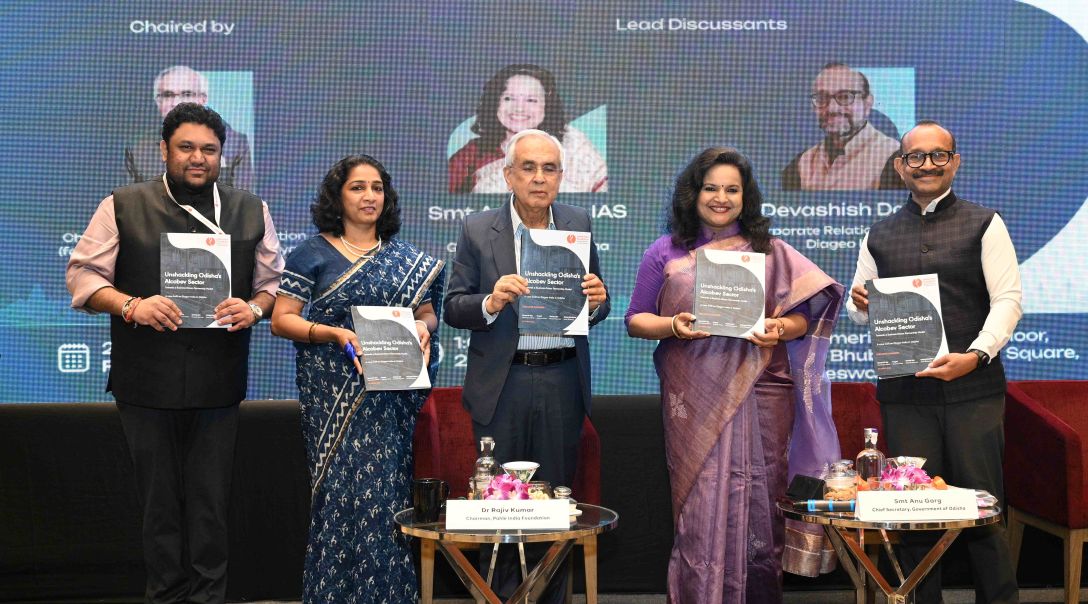
The discussion also provided the back drop for the launch of PIF’s report supported by Diageo India, titled Unshackling Odisha’s Alcobev Sector: Towards a Business-Driven Partnership Model. The study examines the economic footprint of Diageo India (USL) in Odisha and the wider impact of the alcoholic beverages industry to the state’s economy. It assesses the industry’s fiscal contribution, employment linkages, procurement patterns, environmental performance and the regulatory conditions affecting investment.
Using Diageo India’s vendor expenditure for FY2024-25, the study’s expenditure-driven assessment estimates ₹647.9 crore in associated gross value added (GVA) across India, of which ₹350.5 crore accrues within Odisha. Within packaging-related manufacturing (glass, plastic and paper), the estimated GVAis₹245.1croreoutsideOdisha. These figures are derived from the vendor-expenditure method, which is distinct from the input-output estimates presented below.
ThefindingspointtoanopportunitytostrengthenOdisha’smanufacturingbasebydeveloping local suppliers of packaging materials and other industrial inputs. Such investments have potential to increase the proportion of economic activity retained within the state and create additional linkages with domestic enterprises.
The report also establishes the sector’s significance for state finances. Odisha collected ₹11,429 crore in excise duty and VAT from the alcoholic beverages industry in FY25 ,compared with ₹7,622 crore in FY2021-22. Diageo India’s excise duty contribution stood at ₹1,434 crore in FY2024-25, equivalent to 12.6% of the state’s combined excise duty and VAT collections from the sector. This is a different measure from its share of excise collections alone. The report argues that realising these opportunities requires attention to the regulatory and institutional conditions under which businesses operate. It identifies scope for improving wholesale distribution infrastructure, reviewing pricing and packaging regulations, and establishing regular consultation between government and industry.
Among its recommendations are the creation of an Odisha Alcobev Policy Council and an Anchor Firm Compact. The se mechanisms would seek to connect greater policy predictability with measurable commitments by participating companies towards investment, local employment, skills development and community initiatives.
The study also assesses environmental performance at Diageo India’s manufacturing facilities, documenting improvements in water and energy efficiency per unit of production. These findings underline the importance of considering productivity and resource efficiency alongside industrial expansion.
Devashish Dasgupta, Director of Corporate Relations, Diageo India, added, “Odisha’s strong economic trajectory presents a significant opportunity to unlock the full potential of the alcobev sector as a contributor to the state’s growth. Diageo India is proud to beasignificantpartnerinthisjourney,contributing₹1,434crore in excise duty in FY2024-25 and accounting for 20.8% of the relevant state excise collections (excluding VAT). Beyond revenues, our contribution extends to investment, employment, local value creation and community development.
As Odisha advances towards its Viksit Odisha 2047 ambition, we believe a progressive partnership between government and industry can unlock further investment, strengthen ease of doing business and drive responsible, sustainable growth. We remain committed to being a long-term partner in Odisha’s growth story. Our ambition is not simply to grow in Odisha, but to grow with Odisha.”
As Odisha works towards its Vision2036 and 2047 economic objectives, the report emphasises the importance of building stronger connections between existing industrial activity and local enterprise development. Its findings suggest that strengthening supplier capabilities and improving regulatory efficiency could help Odisha capture more value from its manufacturing economy, while maintaining appropriate fiscal, environmental and public-health oversight.