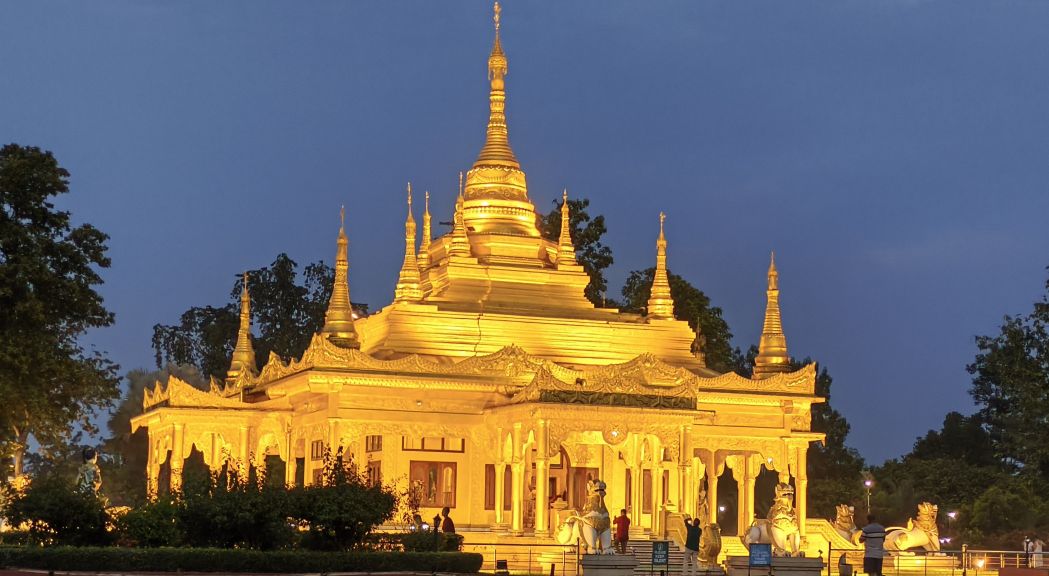
Buddha’s Holy Relics: The Ministry of Culture, Government of India, in collaboration with the Government of Arunachal Pradesh, the International Buddhist Confederation (IBC) and the National Museum, New Delhi, is organising an exposition of the Holy Relics of Shakyamuni Buddha in Arunachal Pradesh from 31 October to 21 November 2026. The exposition will cover three important centres of Buddhist faith and heritage—Tawang, Bomdila and Namsai, providing devotees and members of the public an opportunity to pay homage to the Sacred Relics.
Union Minister of Culture and Tourism, Shri Gajendra Singh Shekhawat, is scheduled to participate in the inaugural ceremony at the historic Gaden Namgyal Lhatse (Tawang Monastery) on 31 October 2026. The programme will be attended by distinguished representatives of the Government of Arunachal Pradesh, venerable members of the Buddhist Sangha, representatives of Buddhist institutions, devotees and other dignitaries.
The exposition is being organised in recognition of the deep spiritual significance of the Holy Relics and Arunachal Pradesh’s distinctive place in India’s Buddhist cultural landscape. It also reflects the Government of India’s continuing commitment to the protection, preservation and dissemination of the country’s Buddhist heritage, and to strengthening cultural and spiritual connections with Buddhist communities in India and abroad.
Ceremonial Movement and Inauguration at Tawang
The Holy Relics, presently preserved at the National Museum, New Delhi, will commence their sacred journey with ceremonial observances at the Museum on the night of 30 October 2026. They will thereafter be taken to Air Force Station Palam for onward transportation to Arunachal Pradesh.
As per the proposed movement itinerary, the Holy Relics are scheduled to depart from Palam in the early hours of 31 October 2026 by a special Indian Air Force aircraft and reach Air Force Station Borjhar, Guwahati, before being transported by helicopter to Tawang.
Upon arrival, the Holy Relics will be received with due religious ceremony and reverence. They will thereafter be taken to Tawang Monastery for installation and the inaugural ceremony, scheduled between 10:00 AM and 11:30 AM on 31 October 2026.
A further inaugural function, together with the opening of the associated exposition and exhibition, is scheduled for 1 November 2026, with the Chief Minister of Arunachal Pradesh, Shri Pema Khandu, as the Chief Guest.
The occasion coincides with the observance of Lhabab Düchen, a significant festival in the Tibetan Buddhist tradition commemorating the Buddha’s descent from the heavenly realm. The exposition will thus bring together religious observance, cultural heritage and public participation in a spiritually meaningful setting.
The movement and installation of the Holy Relics are being planned with particular attention to their sanctity, security and conservation requirements. The Ministry of Culture is coordinating with the Ministry of Defence, Indian Air Force, Government of Arunachal Pradesh, National Museum and other concerned agencies for the necessary operational arrangements.
Sacred Piprahwa Relics: An Extraordinary Archaeological and Spiritual Heritage
The Holy Relics being taken to Arunachal Pradesh originate from Piprahwa in present-day Siddharthnagar district, Uttar Pradesh, an archaeological site associated with ancient Kapilavastu and the Shakya tradition of Lord Buddha.
Piprahwa occupies a prominent place in the archaeological history of Buddhism. In 1898, William Claxton Peppé excavated a stupa at the site and discovered reliquaries containing bone fragments and precious objects, bringing international attention to the historical and religious significance of the discovery.
Subsequently, the Archaeological Survey of India conducted further excavations between 1971 and 1977, under the supervision of archaeologist Shri K. M. Srivastava. Excavations at deeper levels revealed two additional reliquary caskets containing ancient bone relics traditionally associated with Lord Buddha.
The larger casket contained 12 sacred bone fragments, while the smaller casket contained 10, making a total of 22 sacred relics recovered during these excavations. Of these, 20 are preserved at the National Museum, New Delhi, and two at the Indian Museum, Kolkata.
The relics, comprising ancient osteological material, are regarded as exceptionally rare and are accorded profound religious reverence by Buddhist communities. Their historical and archaeological importance is accompanied by a deep spiritual significance rooted in the long-established Buddhist tradition of relic veneration.
Following the Mahāparinirvāṇa of Lord Buddha at Kushinagar, the tradition of enshrining His corporeal relics in stupas developed into an important expression of Buddhist devotion. Over the centuries, these sacred sites became centres of pilgrimage, religious learning and cultural exchange.
The present exposition offers devotees an opportunity to connect with this ancient spiritual tradition while also drawing attention to the importance of preserving archaeological and religious heritage for future generations.