Written By- Puja Mohapatra
Flowing quietly through the coastal plains of the state, the river Prachi has played a decisive role in nurturing one of Odisha’s richest yet relatively lesser-known cultural landscapes.
Prachi is referred to as ‘Prachi Sarawati’ or ‘Saraswati of the East’ in the Kapila Samhita, underscoring its divine sanctity and cultural importance. Archaeological remains in the form of temples, sculptures, monasteries, ruined forts, inscriptions, and ritual structures are found on both banks of the river, attesting to continuous human activity over centuries.
The river flows through the coastal plains of eastern Odisha, traversing parts of the present-day districts of Cuttack, Khordha, and Puri. Originating from the river Kuakhai, the Prachi runs for approximately 60-78 km before emptying into the Bay of Bengal near Keutajanga village under Kakatpur Police Station.
The Prachi Valley civilisation flourished roughly between the 7th and 16th centuries AD. Despite the river’s comparatively small scale when measured against major rivers such as the Mahanadi, Brahmani, Budhabalanga, Suvarnarekha, or Tel, the valley supported a thriving cultural and political ecosystem. Several major dynasties that ruled ancient Odisha, including the Chedi dynasty of Kharavela, the Shailodbhavas, Bhaumakaras, Somavamshis, Eastern Gangas, and Suryavamshis, were closely associated with the Prachi Valley. In later periods, the region also experienced the influence of Mughal and Maratha rule.
Studies create an impression that Buddhism, Jainism, Shaivism, Saktism and Vaishnavism flourished chronologically and harmonious manner, without disrupting the religious or philosophical life of the people. A number of Jain and Buddhist images were found in the site of Prachi Valley.
Among these traditions, the Shakta cult held a particularly strong influence in the Prachi region. Abundant images of Mahishamardini Durga, ranging from four-armed to twelve-armed forms, have been found at various sites. Alongside Durga worship, several forms of Chamunda associated with Tantric practices were also venerated.
Shaivism and Vaishnavism appear to have developed in parallel, as evidenced by the widespread presence of Shiva temples and Vishnu images, particularly four-armed Vishnu aka Madhava forms. The sacred soil of the Prachi Valley is also associated with the celebrated Sanskrit poet Jayadeva, the author of Geeta Govinda, who was born at Kenduli village, an important ancient site in the region.
Archaeological explorations and surveys have identified several major sites in the Prachi Valley, including Chaurashi, Kenduli, Phulnakhara, Dakshinesvara, Nadiagurudi, Sundergram, Kantapara, Adaspur, Niali, Krishnaprasadgarh, Tola, Chahata, Amaresvara, Kakatpur, Somesvara, Mudgala Madhava, and Kapila Muni Ashrama, etc. A remarkable image of Rishabha Deva is preserved at the Svapnesvara temple near Sundergram. Loose sculptures of Buddha, Varahi, Trivikrama, and Ganesha adorn the outer walls of the Dakshinesvara Shiva temple, where a Yajnavedi is also found.
Kantapara village, located near the northern bank of Prachi, finds mention in the Dhenkanal Copper plate of Tribhuvana Mahadevi, a devotee of Hari of Bhaumakara era 110. Sculptures of Trivikrama Vishnu, Kshetrapala Bhairava, and a four-armed female deity with seven serpent hoods over her head were found at this site.
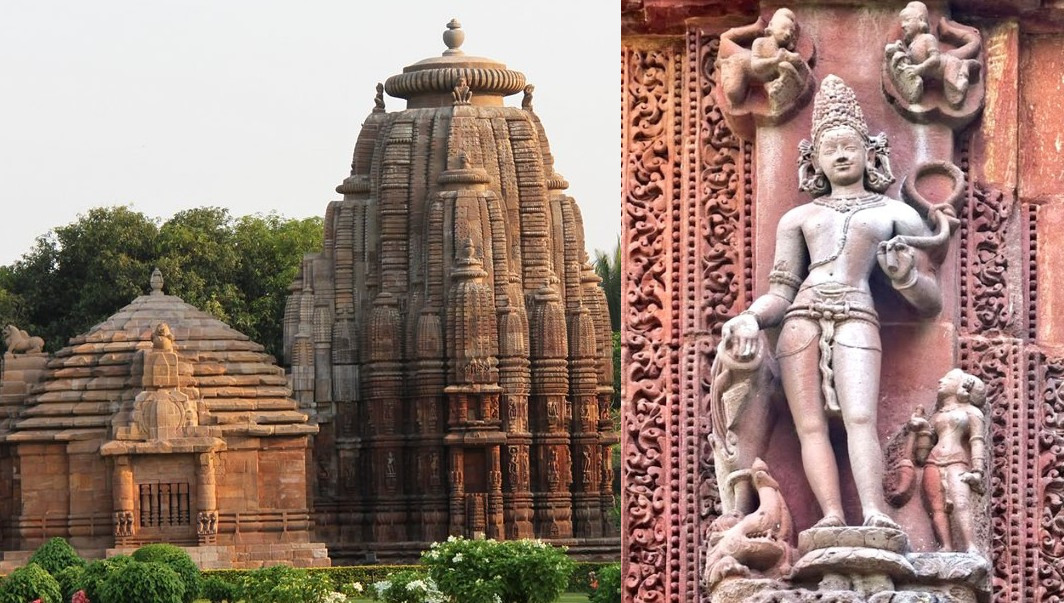
Adaspur is another ancient site on the eastern bank of the Prachi. The medieval pidha temple of Dashabhuja Mahishamardini Durga, worshipped as Budhi Thakurani, is built on the ruins of the original temple near the northern bank of Prachi. The temple facade is furnished with Naga images, erotic sculptures, elephant processions and a Navagraha slab at the entrance. The Varaha Narasimha temple is built of laterite blocks, consists of the sanctum and Jagamohana. Inside the sanctum, the beautiful images of Varaha and Narasimha are installed and worshipped as Varaha Nrusingha. The chlorite image of Shrikrishna and bronze image of Radha are also found near Varaha Nrusingha. Trial excavations at Mallikeswar temple in Adaspur led to the recovery of several antiquities such as pottery of red ware and a terracotta Kamandalu with the image of Saraswati on its neck, dated to circa 9th Century AD.
Chaurashi is one of the major sites. In the Lakshminarayana temple here, the installed image of Lakshmi Narayana is a rare finding as far as its iconographical and sculptural aspects are concerned. In the Varahi temple at the outskirts of Chaurasi, every piece of stone of the main temple is artistically carved. Naga figures at the front façade of Jagamohana remind one of the Rajarani temple in Bhubaneswar. The presiding deity of the temple is Varahi, who sits on a buffalo; fish and blood pots are to be found in her right and left hands respectively. This unique sculpture is made of chlorite stone.
During excavations, various images like Trivikrama, Asthika Jardakatu, Maruka, Buddha, different forms of Bhairava, Chamunda and Vishnu, and Navagraha slabs, were found from different sites of Prachi Valley.
Around 20 brick temples have been identified in Prachi valley. The sanctums of these temples are of Rekha order; there are places for side deities and no carvings on outer walls of main temple, but there are Pada-Kumbha designs similar to those of the stone temples. The Jagamohana has a flat roof and its outer wall is also plain in construction. The Natamandira and the Bhogamandapa which are of later edition are also of plain construction. The compound walls are generally made of ancient bricks; some places have double compound walls as well. Angesvara temple of Pitapara, the ruined Nilamadhava temple of Chahata, Durga temple of Motia and Chandi temple of Kenduli are some of the brick temples in Prachi Valley.
The valley also preserves the remains of several forts, likely constructed between the 12th and 18th centuries AD for defending the areas. The Chudangagada fort, located at the origin of the Prachi, is believed to have been built by Chodaganga Deva of the Ganga dynasty. Other ruined forts, such as Amaraprasadgarh, Krishnaprasadgarh, Golargarh, Mulagarh, Amanakudagarh, and Nipaniagarh, were active during the Maratha period and remained functional until the Paika Rebellion. Golargarh, in particular, survived until that uprising.
Utkal was historically prominent in maritime trade, and despite its smaller size, the Prachi supported several river ports. Trade also flourished along the Chitrotpala, a tributary of the Prachi. Greek geographer Ptolemy mentions a major port at Konark, which might haveflourished in the 1st century AD. Near Chitresvari and Utpalesvara temple, stands half-buried a light post, which might have acted as a signal when ships were plying from the Prachi river to the sea. There is every possibility that this place Chitresvari on the sea may be called Chi-li-ta-Lo of Huen Tsang’s accounts. Huen Tsang during his visit to Odisha might have come through this route.
Nearby stands the ruined structure of Golargarh palace, associated in folklore with a tyrant king and pirates who preyed upon Sadhabas (ancient merchants/mariners). By the 16th century AD, Odisha’s ports were deeply integrated into international trade, and by the 18th century, temple architecture began incorporating designs inspired by Utkaliya boats. Italian visitors are known to have visited factories manufacturing these cargo vessels.
Buddhism exercised a profound, almost overwhelming, influence on Hinduism in the Prachi Valley. This interaction gave rise to a form of neo-Hinduism that absorbed many of the finest elements of Buddhism. As a result of this influence, the Buddha was incorporated into the Hindu pantheon as the tenth avatar of Vishnu. Images of the Buddha are worshipped at several places in the Prachi Valley.
Among the Tantric images, a particularly beautiful and unique image of Vajraghanta is worshipped beneath a tree at Kantikula near Chaurashi. This image is three-faced and six-armed. An eight-armed image of Samkshipta Marichi was discovered near Astaranga in Puri district. During the early phase of Buddhism, the worship of popular deities and spirits, such as Shri (associated with luck and success), earth spirits, mountain deities, the Digpalas, as well as tree, serpent, and river worship, was widespread. The depiction of trees, serpents, and related motifs in Buddhist sculptures suggests the continuation of these ritualistic practices. However, before the dawn of the 7th century AD, Buddhism lost its identity as an independent faith in the region and was gradually assimilated into Vaishnavism.
Jainism flourished in the Prachi Valley alongside Saivism. The discovery of numerous Jain images within Shiva temples at Adaspur supports this view. An image of Rishabhanatha surrounded by the twenty-four Tirthankaras is found in the Svapnesvara temple. The presence of Jain sculptures within Shaiva temples suggests that Adaspur was the principal centre of Jainism in the Prachi Valley during the 6th–7th centuries AD. Jainism had earlier gained a strong foothold in Odisha during the reign of the great Kharavela, during whose rule the Kalinga empire extended from the Ganga to the Godavari.
Before the development of Vaishnavism in the sacred land of Prachi, the entire valley witnessed a powerful and widespread surge of Shaivism. The discovery of numerous images of Shiva in various forms—such as Ardhanarisvara, Uma-Maheshvara, Hari-Hara, Bhairava, Mahayogi, and Tandava—presents a comprehensive picture of its growth. From the point of its origin to its confluence with the Bay of Bengal, the riverbed of the Prachi is dotted with Shiva lingas and rich in antiquities associated with the rise and expansion of Shaivism.
Shaktism played a predominant role in the religious life of the Prachi Valley. The inhabitants experienced a wide range of cult images representing diverse aspects of goddesses. Various forms of Mahishamardini Durga, ranging from two-armed to twelve-armed representations, were worshipped over different periods. Chronologically and iconographically, the two-armed images of Mahishamardini Durga are the earliest and may be assigned to the post-Gupta period or even earlier; such images are extremely rare.
The four-armed Mahishamardini came to be worshipped as Pishta Devi, followed by the six-armed (Sadabhuja) form. The worship of the eight-armed (Asthabhuja) Mahishamardini gained popularity during the Bhauma rule in Odisha. The ten-armed (Dashabhuja) form was the most common and widely worshipped in the valley, as evidenced by the large number of images found either as Pishta Devi or as subsidiary deities. The twelve-armed (Dwadashabhuja) Mahishamardini is later in date and comparatively rare.
The Prachi Valley was also renowned for its numerous images of Chamunda, scattered across the region. In some locations, these images are worshipped as Pishta Devi, while in others they function as subsidiary deities. Unlike Mahishamardini Durga, Chamunda images range from four-armed to twelve-armed forms. The abundance of Chamunda images clearly points to the prevalence of Tantrism, particularly the Kapalika form of worship, during the 8th–9th centuries AD.
Another important Tantric goddess of the Prachi Valley is Varahi, worshipped in the village of Chaurasi. This particular iconographic form of Varahi is not found elsewhere in Odisha. Generally, Varahi images holding a child appear as part of the Sapta Matrika group, datable to the 9th–10th centuries AD. However, the depiction of Varahi without a child may tentatively indicate an earlier phase. The Varahi temple at Chaurasi also bears architectural similarity to the Vaitala Deula at Bhubaneswar.
Vaishnavism also flourished in the Prachi Valley, as evidenced by the discovery of several four-armed images of Lord Vishnu in the Madhava form. The Vasudeva form was likewise worshipped during a certain period. Images of Vishnu in various manifestations, such as Seshasayi Vishnu, Lakshmi-Narayana, Rama, Vaikunthanatha, and the Dashavatara, attest to the widespread prevalence of Vaishnavism.
The Varaha cult, a significant Vaishnava tradition, was prominent in the valley and appears to have received royal patronage during the Ganga rule in Odisha. The Varaha temple at Adaspur, dating to around the 10th century AD, stands as monumental evidence of this tradition.
Writer- Puja Mohapatra, Bhubaneswar, Odisha. Mail Id- [email protected]
Read More- Radiant Faiths: Sun Worship in Odisha and Across Cultures (CLICK HERE)