
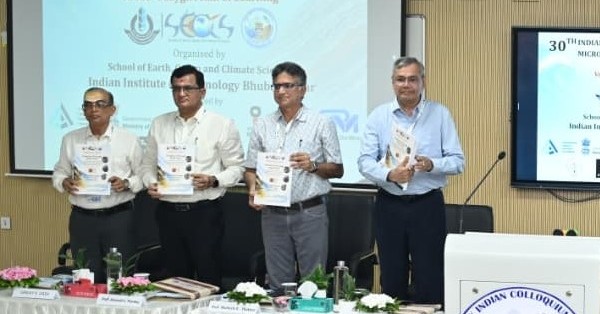
Microfossils: The three-day 30th Indian Colloquium on Micropaleontology and Stratigraphy (ICMS-2026) concluded at the Indian Institute of Technology (IIT) Bhubaneswar, bringing together leading Earth scientists, researchers and industry experts to deliberate on the role of micropaleontology and stratigraphy in addressing challenges related to climate change, energy security and sustainable resource management.
Organised by the School of Earth, Ocean and Climate Sciences (SEOCS), IIT Bhubaneswar, the event marked a significant milestone as IIT Bhubaneswar became the first Indian Institute of Technology to host the prestigious colloquium since its inception in 1971. The conference received 234 research abstracts and featured over 145 poster presentations, along with plenary lectures, keynote addresses and technical sessions covering biostratigraphy, palaeoclimatology, palaeoceanography, marine geology, geochronology, environmental change, energy exploration and applications of artificial intelligence in geosciences.
The inaugural ceremony was graced by Prof. Shreepad Karmalkar, Director, IIT Bhubaneswar; Prof. Avinash C. Pandey, Director, Inter-University Accelerator Centre (IUAC), New Delhi; Prof. Mahesh G. Thakkar, Director, Birbal Sahni Institute of Palaeosciences (BSIP), Lucknow; Prof. Subhasish Tripathy, Director, University Visvesvaraya College of Engineering (UVCE), Bengaluru, and former Head of SEOCS, IIT Bhubaneswar; Shri Sanjay Kumar Dash, Deputy Director General, Geological Survey of India; Prof. Anil K. Gupta, Professor, IIT Kharagpur and Co-Chairman of the ANRF-ARG Programme in Earth Sciences; and Prof. Devesh K. Sinha, President of the 30th ICMS and Professor at the University of Delhi.
Addressing the conference, Prof. Shreepad Karmalkar, Director, IIT Bhubaneswar, emphasized that micropaleontology and stratigraphy have evolved beyond academic inquiry into critical tools for hydrocarbon exploration, resource mapping and understanding global climate dynamics. He noted that microfossils provide valuable insights into ancient environments, evolutionary transitions, and major climatic events, with direct implications for energy security and environmental sustainability.
Speakers collectively underscored the importance of interdisciplinary research, advanced analytical facilities, and emerging technologies such as artificial intelligence and machine learning in advancing Earth science research. They called upon young researchers to leverage these tools and collaborations to address future challenges related to climate resilience, sustainable resource exploration and environmental stewardship.
Delivering the Presidential Address, Prof. Devesh K. Sinha emphasized the enduring importance of micropaleontology in deciphering Earth’s history and understanding evolutionary trajectories. The conference concluded with a shared commitment among participants to strengthen interdisciplinary research collaborations aimed at understanding Earth’s past, addressing present-day environmental challenges and building a more sustainable future.
Dr. Raj. K. Singh, Head of School of Earth, Ocean and Climate Sciences and Convener of the 30th ICMS-2026, delivered the welcome address, and Dr. Sourav Sil, Organizing Secretary of the program, proposed a vote of thanks in the inaugural session.
Throughout the conference, scientists highlighted how microscopic fossils preserved in sedimentary records help reconstruct ancient climates, understand past oceanic and atmospheric changes, track biodiversity evolution, identify hydrocarbon-bearing strata, and generate critical datasets for predicting future environmental scenarios. Discussions emphasized the integration of micropaleontology with geochemistry, sedimentology, isotope studies, molecular biology, and data-driven approaches to better understand Earth system processes.
Technical sessions explored climate variability across geological timescales, monsoon evolution, ocean circulation patterns, sea-level fluctuations, palaeoecological reconstruction, and basin evolution. A key theme that emerged was the growing role of advanced technologies such as artificial intelligence, machine learning, and molecular approaches in fossil identification, geological data interpretation, and palaeoenvironmental studies. The valedictory function was graced by Prof. N. V. Chalapthy Rao, Director, National Center for Earth Science Studies, along with other dignitaries.