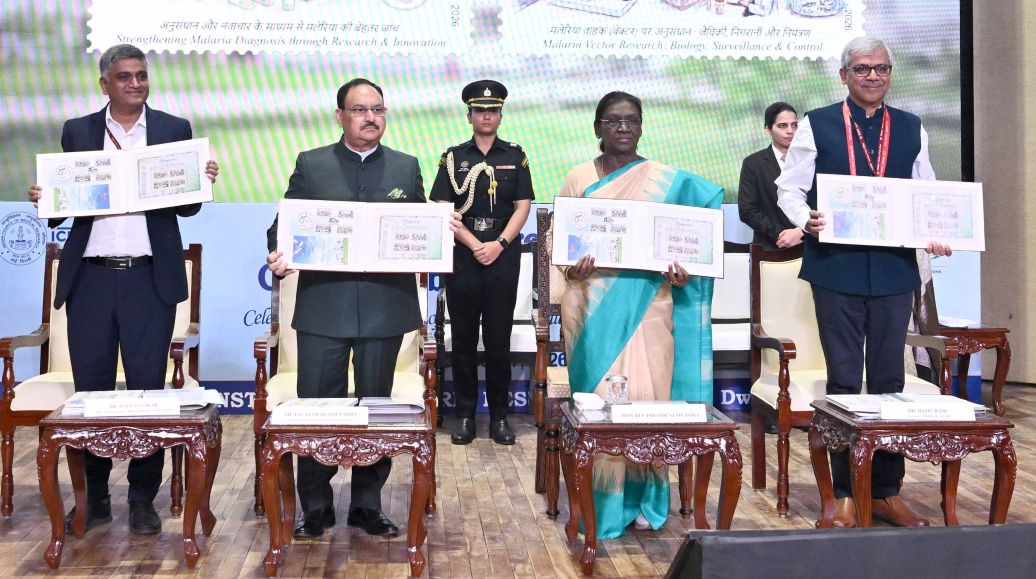
ICMR-NIMR Golden Jubilee: The President of India, Smt Droupadi Murmu inaugurated the year-long Golden Jubilee Celebrations of the Indian Council of Medical Research-National Institute of Malaria Research in New Delhi today.
Speaking on the occasion, the President said that malaria has long been a serious public health challenge in many countries around the world, including India. At the time of independence, it was one of the most critical public health challenges in our country. It is a matter of satisfaction that India has made remarkable progress in malaria control over the last few years.
Improved healthcare services, modern diagnostic techniques, effective medicines, mosquito-control campaigns, and community participation have played a significant role in curbing the spread of this disease. India’s progress toward malaria elimination has received global recognition. In 2024, India moved out of the World Health Organization’s ‘High Burden to High Impact’ category.
This achievement has been made possible through the collective efforts of our public health programs, scientists, healthcare workers, and citizens. The National Institute of Malaria Research has played a pivotal role in this long battle against malaria. Over the past five decades, it has conducted pioneering research in areas such as malaria parasites, mosquitoes, vector control, insecticide resistance, and community-based surveillance.
The President said that new challenges, such as climate change, unplanned urbanization, and the growing resistance of mosquitoes to insecticides, could pose fresh obstacles to the eradication of malaria. In such a scenario, the efforts of healthcare workers alone cannot prevent the spread of malaria. It is also necessary to focus on preventing water stagnation, eliminating mosquito breeding sources, and managing the environment. She expressed confidence that policymakers and the scientific community are making concerted efforts in this direction.
The President said that in recent years, dengue has also emerged as a major challenge in the country. This challenge is likely to become even more formidable due to global warming and shifts in monsoon patterns. Research and studies conducted by the ICMR have provided direction to our fight against diseases such as tuberculosis, leprosy, and kala-azar.
The ICMR has also played a significant role in shaping our national health programs. During the COVID-19 pandemic, it established a nationwide testing network in record time and partnered in the development of India’s first indigenous COVID-19 vaccine. She expressed confidence that the ICMR is also taking effective measures toward the diagnosis of diseases like dengue.
President said that the occasion of a golden jubilee is not only a time to reflect upon and take pride in past achievements, but also an opportunity to set decisive goals for the future. We are moving forward with the objective of building Viksit Bharat by 2047.
Strong collaboration among research institutions, centres of technical and higher education, and the industrial sector is crucial for building a healthy and empowered India. Premier institutions like the ICMR can take the lead in fostering such collaboration. She expressed confidence that the ICMR and its affiliated institutions will contribute to achieving the health-related goals of Viksit Bharat through research, collaboration and innovation.